
Managing Older Tonnage: Technical Challenges and Compliance Risks
- GMOS WORLD

- Jan 29
- 6 min read
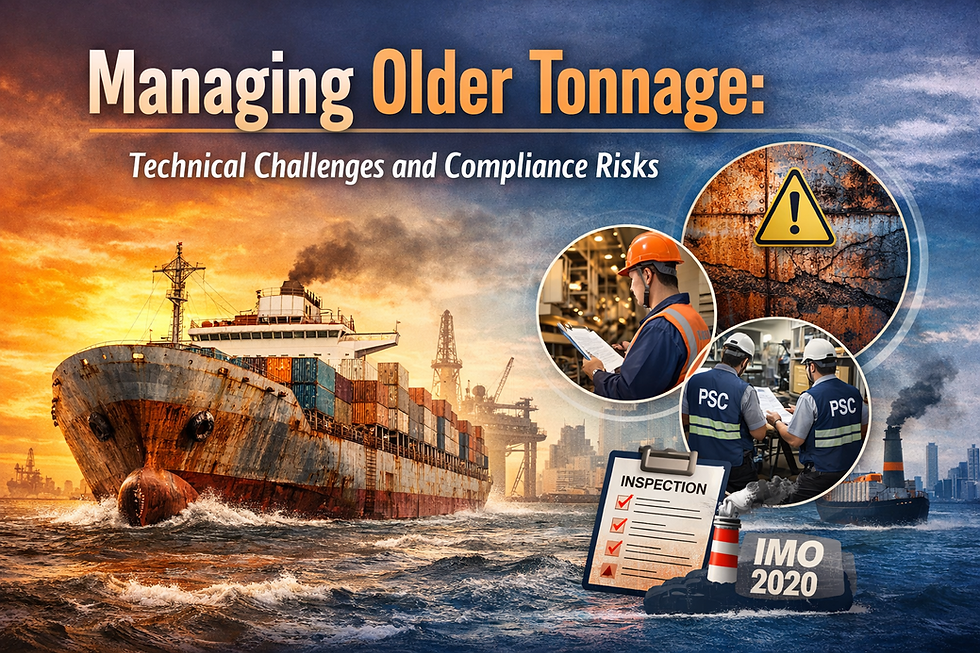
Operating older vessels is no longer just a commercial decision; it is a daily balancing act between cost control, regulatory pressure, and operational reliability. If you manage aging tonnage, you already know the reality. Maintenance costs rise unpredictably. Inspections become more frequent and more detailed. Regulators scrutinize every deficiency. Meanwhile, charterers, cargo owners, and insurers expect the same standards they demand from newer ships.
At the same time, market conditions often make older vessels commercially attractive. Asset values are lower, and in certain trades, older tonnage still plays a critical role. However, as regulations tighten and enforcement intensifies, the margin for error continues to shrink. One overlooked defect or delayed upgrade can quickly escalate into off-hire, detention, or loss of employment.
This creates a fundamental question: how do you keep older vessels trading safely, compliantly, and profitably in today’s regulatory environment? This article breaks down the key technical challenges and compliance risks involved in managing older tonnage and how to address them proactively.
1. Structural Fatigue and Hull Integrity Risks
First and foremost, aging vessels face increasing structural stress. Over time, repeated loading cycles, corrosion, and metal fatigue weaken hull structures, even when maintenance appears adequate on paper.
As a result, inspections become more invasive. Thickness measurements tighten. Class recommendations grow longer. Consequently, repairs often move from planned maintenance to urgent intervention.
If you operate older tonnage, you must anticipate these issues early. Waiting until surveys reveal critical wastage limits your options and increases costs. Instead, proactive structural monitoring allows you to plan steel renewal without disrupting operations.
Moreover, charterers and port state inspectors are less tolerant of structural deficiencies on older ships. Therefore, maintaining documented evidence of continuous hull-integrity management becomes just as important as the repairs themselves.
2. Machinery Reliability and Breakdown Exposure

As vessels age, machinery reliability becomes a primary operational risk. Main engines, auxiliary systems, and electrical components often operate beyond their original design life.
Although regular overhauls help, spare parts become increasingly scarce. Manufacturers discontinue support. Temporary fixes slowly replace permanent solutions.
Because of this, even minor failures can escalate into voyage delays or off-hire claims. More importantly, repeated breakdowns raise red flags during vetting and inspections.
To manage this risk, you must shift from reactive maintenance to condition-based monitoring. Tracking trends in vibration, fuel consumption, and alarm frequency helps identify failures before they occur.
In addition, maintaining detailed machinery histories demonstrates operational control, which can reduce scrutiny during audits and charterer vetting.
3. Increasing Regulatory and Survey Pressure
As a vessel ages, regulatory tolerance decreases. Authorities expect older ships to meet the same standards as newer ones, often with less margin for deviation.
Consequently, port state control inspections become more detailed. Survey intervals tighten. Class societies impose additional conditions and recommendations.
This creates cumulative pressure. One unresolved deficiency often triggers deeper inspections across unrelated systems.
To manage this, compliance planning must become continuous rather than survey-driven. Instead of preparing only before inspections, older vessels require year-round readiness.
Equally important, documentation must clearly demonstrate compliance intent. Inspectors often assess not just the defect, but how systematically it is managed. Strong compliance records can significantly influence inspection outcomes.
4. Environmental Compliance and Retrofit Challenges
Environmental regulations represent one of the most complex challenges for older tonnage. Systems such as ballast water treatment, fuel changeover arrangements, and emissions controls were rarely part of original designs.
As a result, retrofitting becomes technically challenging and operationally disruptive. Space constraints, power limitations, and integration issues increase project risk.
Furthermore, non-compliance is no longer tolerated. Fines, trading restrictions, and reputational damage now follow environmental breaches quickly.
Therefore, environmental compliance must be assessed not only from a regulatory standpoint but also from a technical feasibility perspective. Not every vessel can justify every retrofit.
In many cases, realistic compliance planning helps owners decide whether to upgrade, limit trading areas, or exit certain markets altogether.
5. Crew Familiarity and Human-Factor Risk

Older vessels often rely heavily on crew experience rather than automation. While this can be a strength, it also increases human-factor risk.
As systems age, operating procedures become more manual, and workarounds develop. Documentation sometimes fails to reflect actual practice onboard. This gap becomes dangerous during inspections or emergencies. New crew members may struggle to adapt. Inspectors may interpret informal practices as non-compliance.
To mitigate this, targeted crew training becomes essential. Familiarity with aging systems, emergency response under degraded conditions, and proper record-keeping all matter.
Additionally, stable crewing significantly reduces risk. Crew continuity ensures that vessel-specific knowledge is retained and transferred correctly.
6. Commercial Risk and Charterability Concerns
Finally, older tonnage faces increasing commercial pressure. Charterers apply stricter vetting. Insurers demand higher premiums. Certain terminals restrict access based on age.
As a result, technical issues quickly translate into lost employment. Even compliant vessels may struggle if documentation, inspection history, or maintenance trends raise concerns.
To protect charterability, owners must actively manage the vessel’s compliance narrative. This includes clean inspection records, transparent maintenance planning, and timely closure of deficiencies.
Moreover, aligning commercial expectations with technical reality avoids disputes. Clear disclosure builds trust and reduces the risk of post-fixture conflict.
In today’s market, managing perception is often as important as managing condition.
Conclusion
Managing older tonnage is not about keeping vessels just compliant enough to pass inspections. It is about maintaining control in an environment where scrutiny is constant and tolerance is low.
Every technical weakness, if unmanaged, becomes a compliance risk. Every compliance gap, if repeated, becomes a commercial liability.
However, when approached strategically, older vessels can continue to trade safely and profitably. This requires early planning, honest technical assessments, disciplined maintenance, and strong documentation.
Ultimately, success lies in shifting from reactive problem-solving to proactive risk management. When you understand the limitations of older tonnage and address them systematically, you protect not only the vessel but also your operations, reputation, and long-term value.
FAQ
Q1. What age is considered “older tonnage” in today’s shipping market?
In most commercial and regulatory contexts, vessels 15 years and older are considered older tonnage. In regions such as India, the Middle East, and Southeast Asia, vessels over 20 years face increased scrutiny from port state control, charterers, and insurers, particularly in oil, bulk, and offshore trades.
Q2. Why do older vessels face higher port state control risk in Asia and the Middle East?
Port state control authorities in India, Singapore, the UAE, Saudi Arabia, and China apply stricter inspection standards to aging vessels based on historical correlations between vessel age, deficiencies, and incidents. Older tonnage is often subject to more thorough inspections, increasing the risk of detention if maintenance or documentation is weak.
Q3. Can older tonnage still trade compliantly in India and Middle East ports?
Yes, older vessels can trade compliantly if they maintain strong class status, clean inspection history, valid environmental systems, and documented maintenance programs. Authorities focus more on condition and compliance performance than age alone, especially in major regional ports.
Q4. What are the biggest compliance challenges for older vessels operating in Asia?
The most common challenges include structural wastage, machinery reliability, environmental retrofits, and crew familiarity with aging systems. In Asia, compliance failures often relate to ballast water management, fuel changeover procedures, and record-keeping deficiencies.
Q5. How do environmental regulations impact older tonnage in the Middle East and Asia?
Environmental regulations such as IMO sulfur limits, ballast water management rules, and emissions controls significantly affect older vessels. Retrofitting these systems is often complex due to space and power constraints, making compliance planning critical before operating in environmentally regulated ports.
Q6. Do charterers in India and the Middle East avoid older vessels?
Charterers do not automatically avoid older tonnage, but they apply stricter vetting criteria. Vessels with poor inspection records, recurring deficiencies, or unclear maintenance histories are less charterable, regardless of market conditions.
Q7. How can shipowners reduce compliance risk for aging vessels in Asian trade routes?
Shipowners can reduce risk by implementing continuous compliance monitoring, proactive structural and machinery maintenance, targeted crew training, and transparent documentation practices. Clean inspection histories and early closure of deficiencies significantly improve outcomes.
Q8. Are older vessels more expensive to insure in Asia and the Middle East?
Yes. Insurers often apply higher premiums, deductibles, or trading restrictions to older tonnage operating in high-traffic or high-risk regions such as the Indian Ocean and Arabian Gulf. Strong maintenance records and compliance performance can help mitigate insurance costs.
Q9. Is it worth retrofitting older vessels for long-term Asian operations?
The decision depends on technical feasibility, regulatory timelines, and commercial employment prospects. In many cases, partial compliance strategies such as trade restrictions or shorter employment cycles offer better returns than full retrofits.
Q10. What is the biggest mistake operators make when managing older tonnage?
The most common mistake is reactive compliance management. Waiting for inspections to identify problems increases cost and operational risk. Proactive planning, realistic assessments, and early intervention are essential for keeping older vessels compliant and commercially viable.


